
Statistics reveal that a significant proportion of Startups, up to 90%, face failure. Approximately 10% of these Startups cease operations within their inaugural year, while a staggering 70% do not endure beyond their second to fifth years. The primary factors contributing to this high rate of failure include:
- Inadequate comprehension or insufficient research into market needs, accounts for around 40% of failures.
- Budget constraints cited as a contributing factor in 30% of cases.
- Intense competition and the success of rival companies constitute a significant factor in 20% of startup failures.
- Issues related to marketing, pricing, and design, contribute to about 10% of Startup collapses.
Creating a Minimum Viable Product (MVP) proves to be an effective strategy for Startups to navigate potential pitfalls and successfully bring their projects to fruition. This blog, provide you with insights into the process of MVP product development.
What Is an MVP in Product Development?
In product development, an MVP can be succinctly defined as a trial version of a product encompassing essential features designed to captivate end-users.
The MVP development process typically involves multiple stages and can be executed through various software development methodologies and techniques. The ultimate objective of MVP development for Startups includes:
- Confirming the viability of the product.
- Identifying its strengths and weaknesses.
- Assessing the response of the target audience to the product.
The primary significance of constructing an MVP for Startups lies in steering the product toward success by reducing costs, expediting development, and incorporating genuine feedback from actual consumers for continuous improvement.
Why Do You Need a Minimum Viable Product?
An MVP stands out as a potent tool at the start of a product development journey. Initiating the product development life cycle with the creation of a minimum viable product serves as a litmus test, revealing the true worth of your idea and providing guidance on the safest path forward in the quest for product-market fit.
Moreover, MVP development serves as a key for forging connections with the target audience at reduced costs, while concurrently expediting the delivery of the product.
The effectiveness of the MVP approach has been convincingly demonstrated by industry giants like Spotify, Amazon, and Airbnb. Furthermore, this strategy has proven beneficial for numerous Startups, both large and small, with promising product ideas that evolved into bestsellers through a well-chosen and successful implementation of the MVP strategy.
Benefits of MVP Development for Startups
The benefits of an MVP are intricately connected to its primary purpose, goals, and features. We will delve into these aspects, examining in detail how an MVP for Startups can deliver value and have a positive impact on a project.
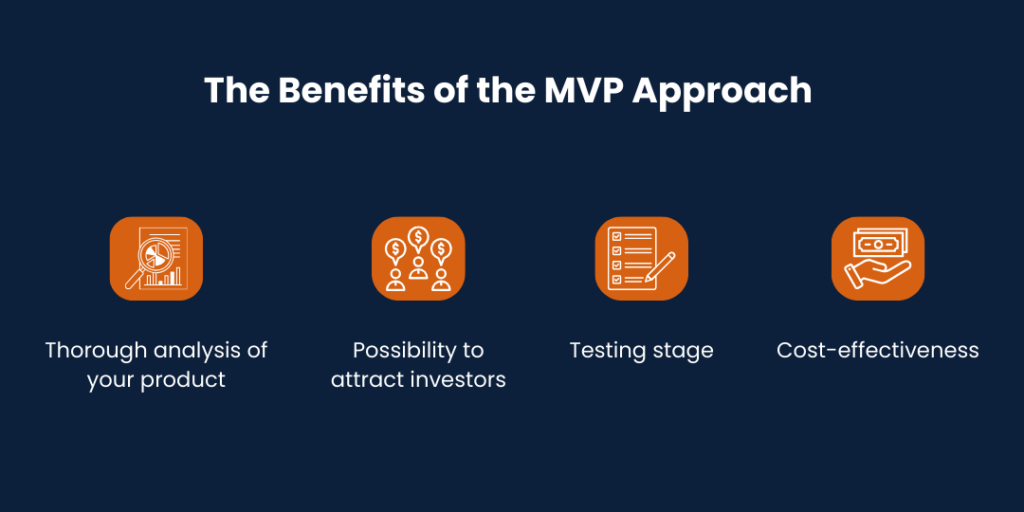
Thorough analysis of your product
Customer feedback becomes invaluable, providing insights into the most and least appealing aspects of your product or service. This information enables you to enhance your offering, address user needs effectively, and establish competitiveness in the market.
Possibility to attract investors
Having a functional MVP for demonstration significantly enhances your prospects of attracting investors, making it a best practice for pitch deck creation. Investors are more inclined to engage with a project that is tangible and operational, as opposed to a mere conceptual idea.
Testing stage
The testing stage is a pivotal element contributing to the popularity of MVP development for Startups. The flexibility it offers allows for the easy removal of unnecessary functions, bug fixes, and the addition of new features during usability testing. This adaptability facilitates a smooth implementation of updates, bringing the release date closer.
Cost-effectiveness
MVP product development proves to be cost-effective, addressing the financial challenges that many Startups face due to inefficient planning. It enables the redistribution of funds as needed, ultimately minimizing expenses for the final product and safeguarding the startup budget.
Steps to Build an MVP
Step 1: Define your business concept
Begin by ensuring there is a market demand for your product. Assess the uniqueness of your product idea in comparison to competitors. Establish a measurable long-term business goal, with equally essential success criteria. Document your problem statement and evaluate the project's feasibility.
Step 2: Conduct market research
Investigate the offerings of your competitors and perform a user analysis. Consider the market size, ensuring that there is a viable number of potential customers willing to invest in your software for the success of your MVP.
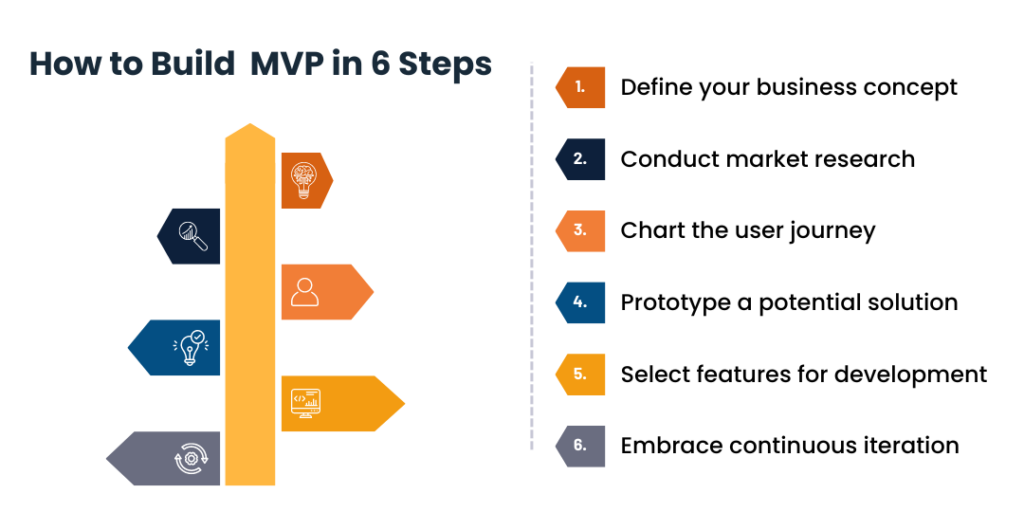
Step 3: Chart the user journey
Prioritize user-centric thinking in MVP development by mapping out user journeys. Identify users and the necessary actions to achieve their goals. Focus on the goals your users aim to accomplish, and pinpoint areas of user pain points to identify opportunities for value addition.
Step 4: Prototype a potential solution
While some may consider this step optional, creating a prototype serves as an essential visualization of a working solution. It complements the MVP, which is a product with core functionality. Both serve distinct but valuable functions in the development process.
Step 5: Select features for development
At this stage, determine the essential MVP functionalities necessary for the success of your minimum viable product. Ensure that these functionalities align with the overarching goal of your product. Building a prototype aids in validating U&I, suggesting improvements to be incorporated into the MVP. Start seeking feedback early to compile a list of crucial features for MVP implementation.
Step 6: Embrace continuous iteration
Completion of the MVP is not the endpoint; continuous gathering of feedback and testing changes is essential. This iterative process ensures the development of a product that resonates with and is loved by your customers.
How Bitsol Can Help You Build an MVP?
Bitsol, a reliable Technology Partner, enables Startups with cutting-edge technology to transform their vision into practical solutions. Our expertise lies in developing customized software solutions for Startups, allowing them to transform, scale, and achieve exponential business growth.
Need to build an MVP?
We are happy to assist, Contact us Now!