A Proof of Concept (PoC) is a preliminary step in the innovation process where an idea or technology is tested for feasibility in real-world applications. This stage is crucial for validating whether a vision can be turned into a practical solution before significant resources are invested. Once a PoC is successful, startups face critical decisions about advancing their product.
PoCs can take various forms, such as wireframes, presentations, screenshots, sketches, or documentation. Ideally, they combine several formats to provide comprehensive validation. After a successful PoC, startups in software development have two main paths: prototyping or directly developing a Minimum Viable Product (MVP).
Navigating these next steps requires strategic planning and decision-making to transition from concept to market-ready product effectively. Let's explore these steps.
Drafting the Proof of Concept Report
Transitioning from a Proof of Concept (PoC) to a prototype involves moving from theoretical validation to practical exploration. Key considerations during this phase include prioritizing features that received positive feedback during the PoC to ensure alignment with user needs. Incorporating elements of user interface and experience design is crucial, as the prototype will be more interactive and closer to the final product than the PoC.
Treating the PoC as a methodology rather than a mere output means assessing the idea's viability based on sound data, whether qualitative or quantitative. It's important not to iterate immediately into a prototype but to provide data-informed insights to justify pursuing the product idea, suggest improvements, or recognize potential pitfalls.
Creating a Proof of Concept report enriches this process by compelling the team to articulate insights and next steps. This report should include research, PoC artifacts (such as wireframes or sketches), and any data generated. Additionally, it should cover assumptions, discoveries, opportunities, and risk factors, along with key functional and technical specifications to demonstrate the solution's feasibility.
The Path from PoC to Prototype
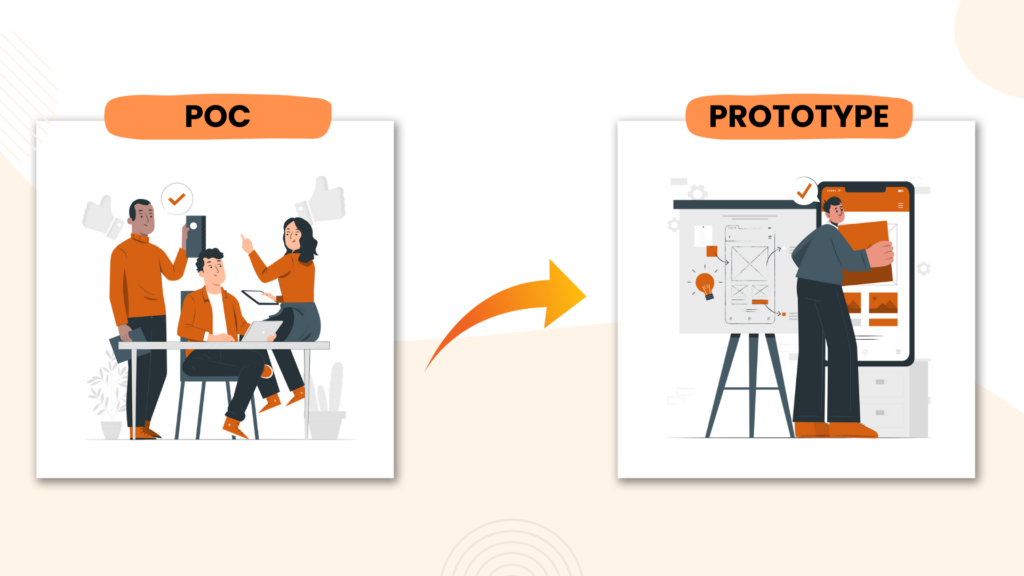
A prototype is an early product version designed to assess functionality and design by simulating the user experience (UX) and showcasing key features. Moving from a Proof of Concept (PoC) to a prototype serves several objectives, such as articulating critical workflows and examining the UX and design concepts.
This transition allows product teams to assess the desirability of the product in terms of its functionality and user appeal. Key areas of focus when building a prototype include understanding how representative users interact with the product, addressing target customers' needs and problems, validating the product workflow, and evaluating key features and functionalities with actual users.
To ensure that the final product meets the needs and expectations of the market, the product must be refined based on user feedback at this stage. Through iterative testing and validation, prototypes help bridge the gap between concept and market-ready products, guiding the development process toward a solution that meets user needs and stands out in the market.
Building the Minimum Viable Product (MVP)

The Minimum Viable Product (MVP) is a crucial step in product development, representing the first version released to actual users. The MVP aims to test business hypotheses with minimal features and gather user feedback for iterative improvement.
Strategies for MVP development focus on essential features to solve key problems for your target audience, reducing costs, and accelerating time to market. Launching the MVP to a limited user base gathers vital feedback for adjustments in future versions, ensuring quality standards that reflect well on your brand and meet user expectations.
The MVP validates product desirability and market fit by testing core functionalities with the target audience. It plays a crucial role in refining go-to-market strategies and ensuring alignment with the right marketing and distribution channels. Additionally, it tests the viability of a profitable business model by assessing user interest and potential traction for growth.
MVPs can be low-code products or implemented solutions limited in scope. Types of MVPs include Minimum Marketable Product (MMP), Minimum Marketable Feature (MMF), and Minimum Lovable Product (MLP). Each type emphasizes different aspects of market readiness and user engagement, guiding the product development process toward a sustainable and successful launch.
Securing Funding and Scaling Plans
Once your Minimum Viable Product (MVP) has demonstrated market fit and attracted user interest, securing additional funding is crucial for scaling effectively. At this pivotal stage, startups often benefit greatly from partnering with a technology firm that offers specialized expertise in product development and fundraising strategies.
A technology partner can provide invaluable support throughout your product development journey. They can offer technical expertise, efficient development, innovative solutions, and strategic guidance. Here are the viable funding options available for startups:
- Venture Capital (VC): Ideal for high-growth startups, VCs invest substantial capital for equity, providing strategic guidance, industry expertise, and extensive networks to accelerate expansion.
- Angel Investors: These individual investors offer capital in exchange for equity or convertible debt, providing personalized mentorship and leveraging their entrepreneurial experience to foster startup growth.
- Crowdfunding: Platforms like Kickstarter and Indiegogo enable fundraising from a broad audience, validating market interest and generating initial capital that can attract further investment.
Choosing the right funding source or combination depends on your startup's needs, growth stage, and strategic goals, with each option offering distinct advantages for scaling operations effectively.
Executing Product Development
Developing a software product involves an evolving process that makes it difficult to decide when an app is ready for public release beyond its initial MVP stage. Once you believe your app meets usability standards for its target audience, even if initially for a smaller group, it's time to deploy it for production. Early phases like Proof of Concept, prototype, and MVP define this preparedness.
Early production phases, such as alpha or beta releases, further confirm the fit between the product, market, and distribution channels, refining strategies before a full launch. After launching, the focus shifts to refining the app based on continuous user feedback to improve its appeal, growth potential, and revenue generation.
It's crucial to develop a robust marketing strategy targeting diverse channels and customer segments for maximum impact before launch, ensuring the app can handle increased user volumes without performance issues. Post-launch, prioritize ongoing improvements informed by user feedback and explore expansion opportunities based on market trends and user data.
Adaptation and Course Correction
Creating a digital product is a complex and nonlinear journey. It goes beyond simply progressing from idea to Proof of Concept, prototype, MVP, and production, and then releasing a fully polished product. It is crucial to delay prototyping if your Proof of Concept reveals areas that require modification or advises a rethink in response to user feedback. Instead, proceed with adaptation and refinement as necessary.
Creating a strong Proof of Concept (PoC) is crucial for the project's success and can also help you secure funding. A well-executed PoC not only validates your initial concept but also demonstrates feasibility and potential value to stakeholders. To achieve this, collaborating with a technology partner can be invaluable. They bring expertise in development methodologies, technical feasibility assessments, and scalability considerations, which are essential for shaping a robust PoC.
How Bitsol Can Help You Transform Your Idea into a Product?
Bitsol, a reliable technology partner, enables startups with cutting-edge technology to transform their vision into practical solutions. Our expertise lies in developing customized software solutions and product design services for startups. This allows them to transform, scale, and achieve exponential business growth.